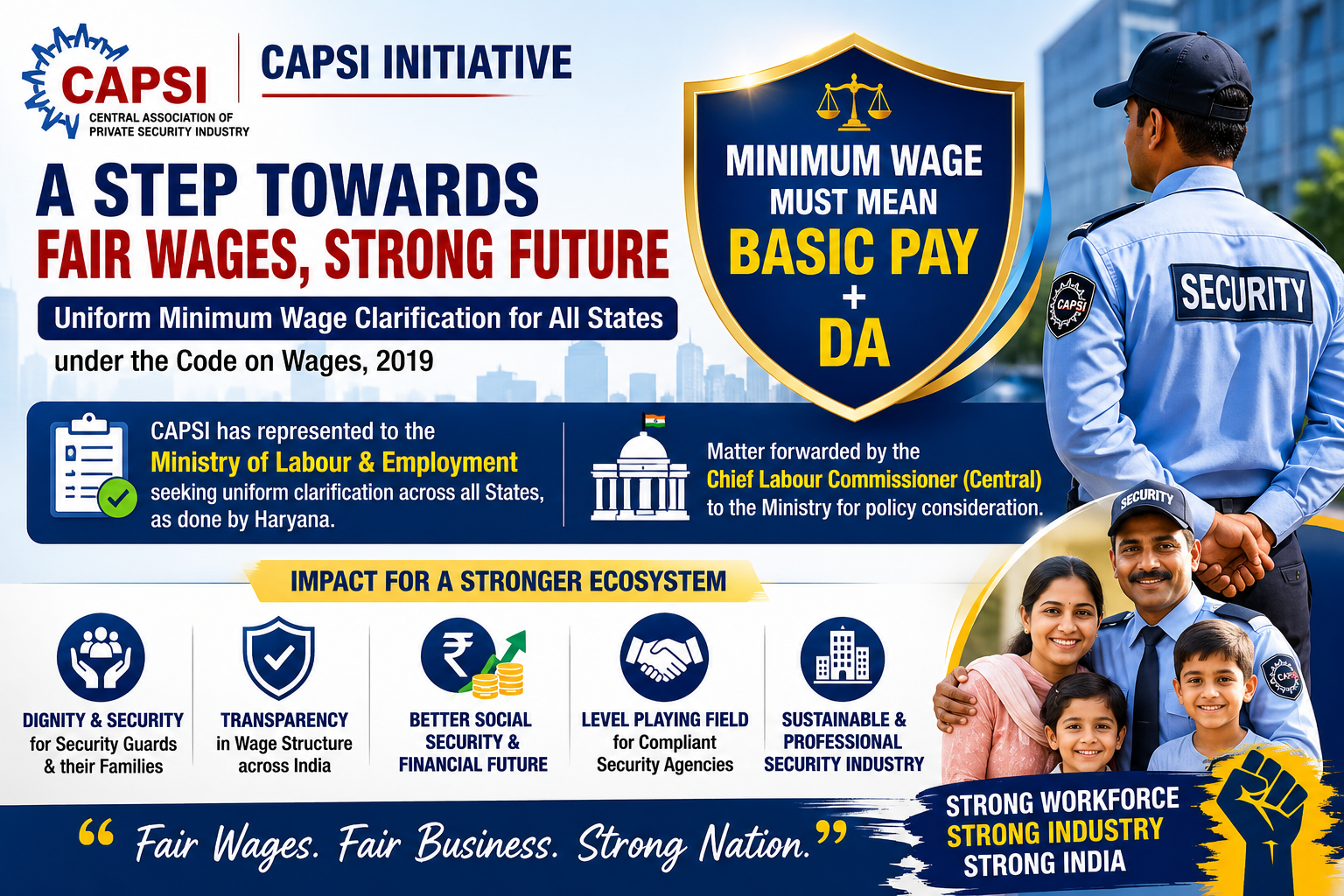
“A landmark labour policy initiative that could redefine wage transparency, social security benefits, industry competitiveness, and workforce management across India’s private security sector.”
The Central Association of Private Security Industry (CAPSI), under the leadership of Chairman Shri Kunwar Vikram Singh, has taken a significant national initiative by urging the Ministry of Labour & Employment to issue a uniform clarification on the structure of minimum wages across all States under the Code on Wages, 2019.
The trigger for this representation is the recent Haryana Government notification, which clearly states that minimum wages comprise only Basic Pay and Dearness Allowance (DA) and cannot be fragmented into multiple allowances by employers. CAPSI has requested that similar clarity be extended across India to eliminate ambiguity and ensure uniform implementation of wage laws.
The Office of the Chief Labour Commissioner (Central) has subsequently forwarded the representation to the Ministry of Labour & Employment for examination and policy consideration.
This development has the potential to become one of the most consequential labour reforms affecting India’s Private Security Industry in recent years.
Why CAPSI’s Intervention Matters
The Private Security Industry is among India’s largest employment generators. More than 10 million individuals are directly and indirectly engaged in security services, protecting industries, commercial establishments, residential communities, critical infrastructure, logistics networks, educational institutions, hospitals, airports, ports, and public spaces.
Security guards are often the first line of protection for people, property, and assets. Yet, despite their critical role, many guards continue to face economic challenges arising from low wage levels, fragmented salary structures, and inadequate social security accumulation.
CAPSI’s initiative seeks to address a long-standing concern: the practice of splitting minimum wages into numerous allowance heads, which can dilute the spirit of wage protection legislation.
The objective is not confrontation. The objective is clarity.
The objective is not increasing costs arbitrarily. The objective is ensuring that statutory wages are interpreted uniformly across India and that workers receive the full benefit intended by law.
Impact on Security Guards and Their Families
For the average security guard, salary is not merely a monthly payment. It is the foundation upon which entire families survive.
A typical security guard may be supporting:
- Elderly parents
- A spouse
- Two or more school-going children
- Medical expenses
- Housing and transportation costs
When the basic wage component remains low and a large portion of earnings is shifted into allowances, long-term social security benefits may also remain limited.
A stronger Basic Pay structure can lead to:
Higher Provident Fund Savings
PF contributions are linked to wages. A stronger wage structure translates into higher retirement savings and better financial security after years of service.
Improved Gratuity Benefits
Security personnel who devote years of loyal service deserve meaningful gratuity benefits at the end of their employment journey.
Enhanced Financial Inclusion
Higher formal wages improve eligibility for:
- Housing loans
- Education loans
- Personal credit
- Insurance products
Greater Family Security
For the families of security guards, stronger social security benefits create a safety net during illness, retirement, disability, or unforeseen hardships.
CAPSI’s initiative therefore goes beyond wage administration—it directly impacts the dignity and welfare of millions of Indian families.
Impact on Security Agencies
There is no denying that implementation of such a clarification nationwide would create significant operational and financial implications for security agencies.
Security agencies operate in one of the most competitive and cost-sensitive sectors in India.
Most agencies function on:
- Thin operating margins
- Long payment cycles
- High compliance burdens
- Intense pricing competition
A restructuring of minimum wages could increase costs associated with:
- Provident Fund contributions
- Gratuity provisions
- Bonus calculations
- Leave encashment liabilities
- Insurance-linked benefits
- Statutory compliance obligations
For agencies employing thousands of guards, the cumulative financial impact could be substantial.
However, there is another perspective.
The industry has long suffered from unhealthy undercutting, unrealistic pricing, and non-compliant operators who gain competitive advantage by manipulating wage structures.
A uniform national clarification would create a more level playing field.
Professional and compliant agencies would no longer be disadvantaged against operators who rely on aggressive wage fragmentation to quote lower rates.
In the long term, the reform could strengthen the credibility and professionalism of the security industry itself.
The Likely Reaction of Principal Employers
The most immediate concern will likely arise from principal employers.
Industrial establishments, IT parks, manufacturing facilities, residential townships, hospitals, retail chains, logistics hubs, and infrastructure operators may face increased security service costs.
Their initial reactions may include:
Demand for Cost Justification
Clients will seek detailed explanations regarding revised wage structures and increased statutory liabilities.
Contract Renegotiation
Existing contracts may require revision to reflect changes in labour costs.
Pressure on Service Providers
Some clients may attempt to absorb increased costs by demanding higher productivity from security agencies without corresponding rate increases.
Technology Adoption
Many organizations may accelerate investments in:
- AI-enabled surveillance
- Remote monitoring
- Command and control centres
- Guard tour systems
- Video analytics
- Smart access control systems
The objective will be to optimize manpower deployment while maintaining security effectiveness.
A Historic Opportunity for Workforce Transformation
Rather than viewing this initiative solely as a wage issue, the industry should see it as an opportunity for transformation.
The future of security services cannot be built exclusively on low-cost manpower.
The future lies in:
- Skilled security professionals
- Technology-enabled guarding
- Productivity-based deployment models
- Better training standards
- Enhanced compliance frameworks
- Improved employee welfare
CAPSI’s initiative is therefore not merely a labour law discussion.
It is a call for creating a sustainable, transparent, and respected security ecosystem where security guards receive fair statutory benefits, security agencies compete on professionalism rather than wage manipulation, and clients receive higher-quality services from a stable and motivated workforce.
The Road Ahead
The Ministry of Labour & Employment now has an opportunity to bring much-needed uniformity to wage administration across India.
If adopted nationally, this clarification could become a watershed moment for the Private Security Industry.
There will undoubtedly be challenges.
There will be discussions on costs.
There will be negotiations between agencies and principal employers.
But there will also be greater transparency, stronger compliance, improved worker welfare, and enhanced professionalism across the sector.
CAPSI’s initiative deserves attention because it is ultimately about balancing three equally important interests:
Worker Welfare. Industry Sustainability. National Compliance.
And in a sector that safeguards India’s people, property, and economic assets every day, that balance has never been more important.