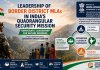
A Democratic Leadership Framework for Secure, Resilient and Prosperous Border Districts
Commander Satyajit Roy (Retd.) Founder – Surakshit Bharat Abhiyan (SBA)
Border District MLAs, Quadrangular Security Mission, Surakshit Bharat Abhiyan, Border Security India, Integrated Border Governance, West Bengal Border Districts, Democratic Leadership, National Security, Border Development, Citizen Participation, Ministry of Home Affairs, Border Management, Secure Border Communities, India Border Policy, MLA Leadership.
India’s borders are not merely geographical boundaries; they are the nation’s first line of defence and the gateway to its economic prosperity, cultural exchange, and national sovereignty. Stretching over 15,000 kilometres across land borders with seven neighbouring countries and more than 7,500 kilometres of coastline, India’s border districts face an increasingly complex security environment. Illegal infiltration, cross-border terrorism, narcotics trafficking, human trafficking, organised crime, cyber-enabled networks, drone intrusions, fake currency, arms smuggling, and demographic pressures have transformed border management into one of India’s foremost national security challenges.
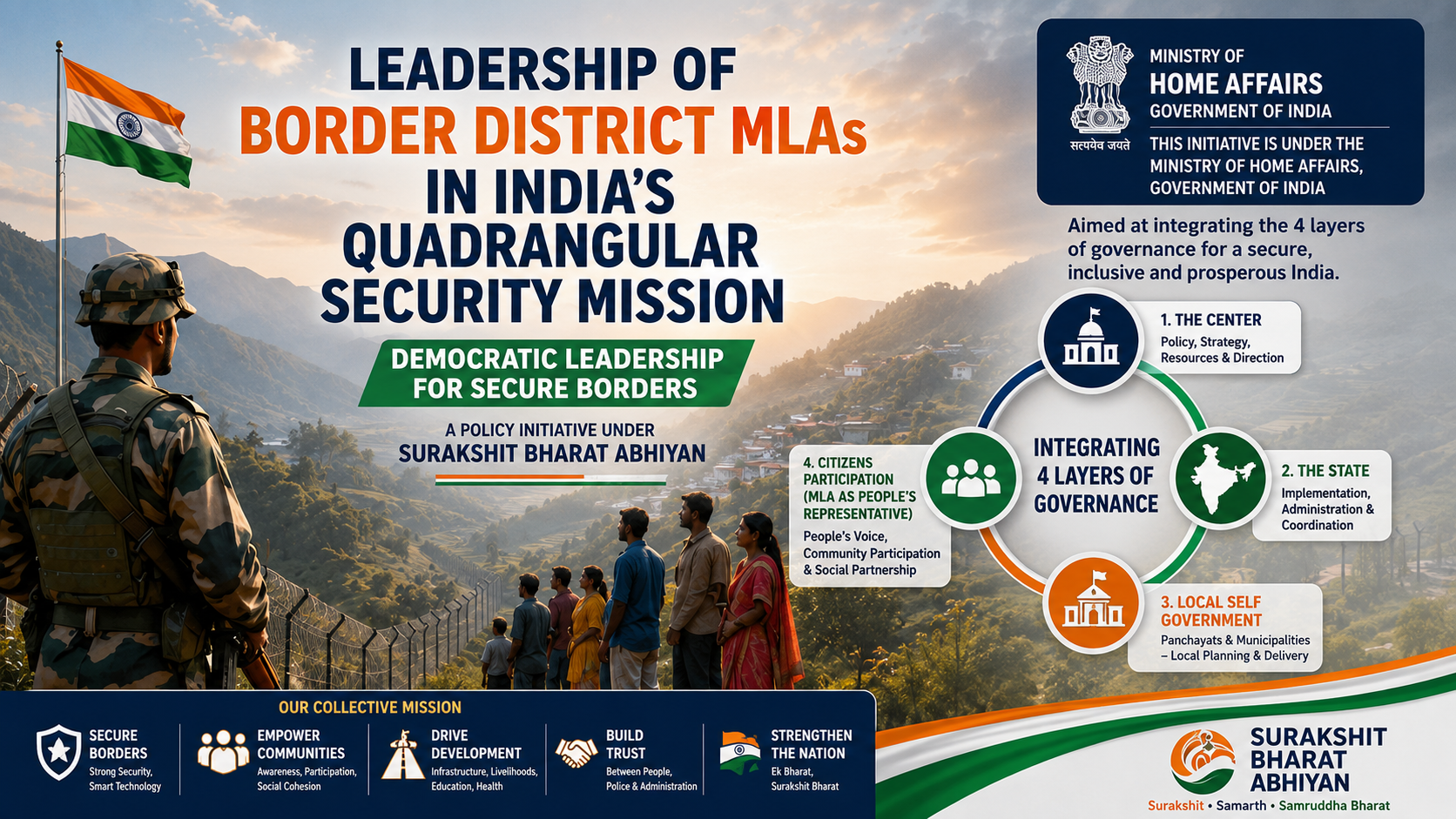
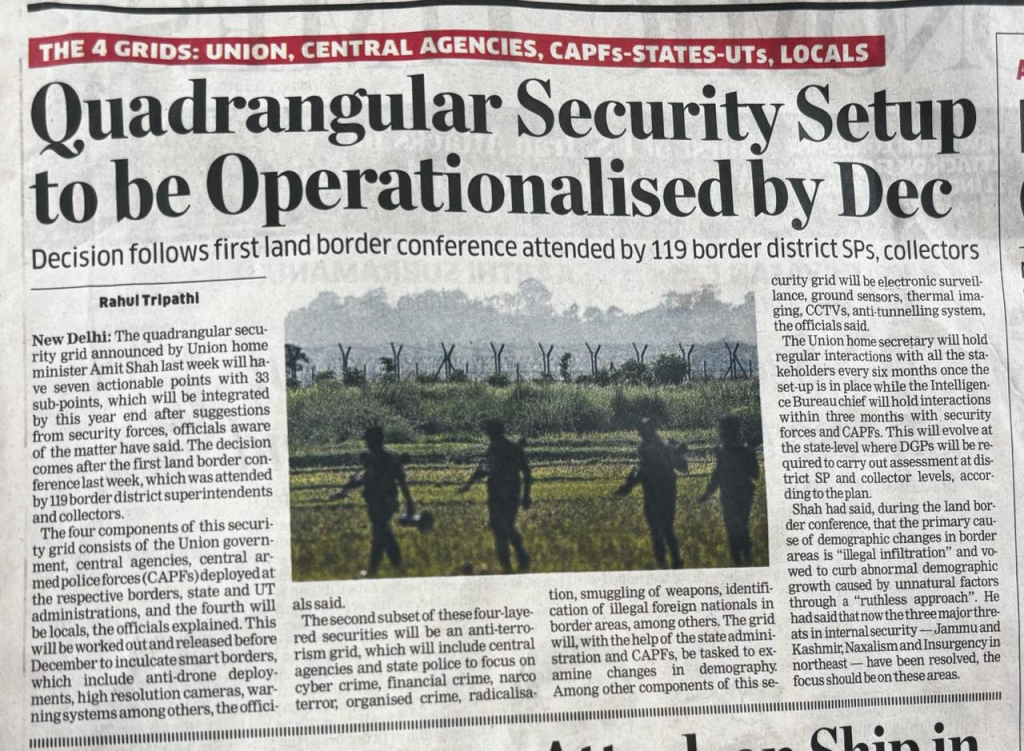
Recognising these emerging threats, the Government of India has announced the establishment of a Quadrangular Security Mission, bringing together four interconnected grids: the Union Government, Central Intelligence and Enforcement Agencies, Central Armed Police Forces (CAPFs) working alongside State Governments and Union Territories, and Local Governance Institutions. This represents a major evolution in India’s approach to border security—from isolated departmental efforts to an integrated, technology-enabled, whole-of-government framework.
While this initiative rightly strengthens institutional coordination, one critical stakeholder deserves greater recognition: the Member of the Legislative Assembly (MLA). As the elected representative closest to the people, the MLA occupies a unique constitutional position that bridges governance, development, public confidence, and democratic accountability. This paper proposes that Border District MLAs become the recognised leaders of the Fourth Grid—the democratic interface between government institutions and border communities.
A New Dimension of Border Security
Modern border security is no longer defined solely by fences, patrols, and surveillance. Security today depends equally on the resilience of border communities, economic opportunities, public trust, technological readiness, and responsive governance. Experience worldwide demonstrates that borders become secure not only through military capability but also through strong institutions, informed citizens, and sustained socio-economic development.
Border villages should therefore be viewed not as India’s last villages but as India’s first line of national resilience. Their residents are often the first to notice suspicious activity, changing migration patterns, emerging criminal networks, or local vulnerabilities. Empowering these communities through democratic leadership can significantly strengthen the nation’s security architecture.
Why Border District MLAs Matter
Unlike administrative officers or security personnel, who serve fixed tenures, MLAs maintain long-term relationships with their constituencies. They understand local history, culture, livelihoods, demographic trends, and community concerns. They possess the legitimacy to mobilise citizens, influence public opinion, and advocate for developmental priorities through legislative processes.
This paper does not propose any operational role for MLAs in policing or intelligence. Such responsibilities remain exclusively with the designated security and law enforcement agencies. Instead, it recognises MLAs as constitutional leaders who can complement operational efforts through democratic engagement and developmental leadership.
Border District MLAs can:
- Promote public awareness regarding national security and border vigilance.
- Encourage citizen participation in lawful reporting of suspicious activities.
- Advocate for infrastructure and development projects in border villages.
- Facilitate coordination among local governments, district administration, and community organisations.
- Strengthen public confidence in security institutions.
- Promote inclusive growth that reduces vulnerabilities exploited by criminal networks.
Democratic Leadership: The Fourth Grid
The proposed democratic leadership framework rests on four mutually reinforcing pillars:
Grid I – National Leadership
The Union Government establishes national security policy, allocates resources, and coordinates strategic decision-making.
Grid II – Intelligence and Enforcement
Central agencies collect intelligence, investigate organised crime, disrupt terror financing, and counter transnational criminal networks.
Grid III – Operational Security
CAPFs, State Police, District Administration, and specialised agencies provide operational security, surveillance, border management, and law enforcement.
Grid IV – Democratic Leadership
Border District MLAs, Panchayati Raj Institutions, Urban Local Bodies, civil society organisations, educational institutions, and community leaders promote public participation, resilience, and development.
Together, these four grids create a comprehensive model of integrated border governance.
Seven Pillars of MLA Leadership
The proposed framework identifies seven strategic responsibilities for Border District MLAs.
1. Democratic Representation
Represent the aspirations and concerns of border communities before the State Legislature and Government while ensuring that development reaches the nation’s frontier villages.
2. Community Participation
Encourage citizens to become active partners in national security by promoting awareness, legal reporting mechanisms, and responsible civic engagement.
3. Development Leadership
Champion investments in roads, healthcare, education, digital connectivity, drinking water, livelihood generation, tourism, and market access, thereby reducing socio-economic vulnerabilities.
4. Institutional Coordination
Facilitate regular interaction among District Magistrates, Superintendents of Police, BSF, Panchayats, municipalities, and civil society organisations to strengthen governance.
5. Social Cohesion
Promote harmony, constitutional values, and national integration while discouraging misinformation, radicalisation, and social polarisation.
6. Legislative Oversight
Raise constituency-specific issues in the Legislative Assembly, advocate appropriate policy reforms, and monitor implementation of border development programmes.
7. Visionary Leadership
Develop long-term district strategies that integrate security, economic growth, environmental sustainability, disaster preparedness, and community resilience.
Security Through Development
The paper advances a simple but powerful principle:
Secure Borders Require Prosperous Border Communities.
Communities with better schools, healthcare, employment opportunities, digital connectivity, and economic prospects are more resilient to exploitation by criminal or extremist elements. Consequently, border development must be viewed as an integral component of national security rather than a separate welfare agenda.
This approach aligns with national initiatives promoting infrastructure development, technology-enabled governance, and inclusive growth in border areas.
Technology and Citizen Partnership
The Government’s emphasis on electronic surveillance, drones, thermal imaging, anti-drone systems, sensors, CCTV, and artificial intelligence will undoubtedly strengthen operational security. However, technology alone cannot replace community trust.
An effective border management system requires the integration of:
- Smart technology,
- Professional security forces,
- Responsive administration,
- Empowered local communities.
The democratic leadership of MLAs can help build this essential partnership.
Institutional Mechanisms
To operationalise the democratic leadership framework, this paper recommends:
- District Border Coordination Forums chaired by the District Magistrate with participation from security agencies and elected representatives.
- Quarterly Border Development Review Meetings.
- Village Awareness and Civic Participation Programmes.
- Youth and Women’s Community Leadership Initiatives.
- Border Tourism and Cultural Promotion Committees.
- Annual Border Governance Report Cards.
- District-level public outreach on legal migration, anti-trafficking, and national security awareness.
These mechanisms are consultative and developmental in nature, fully respecting the operational autonomy of security agencies.
A West Bengal Opportunity
With the country’s longest international land border, West Bengal occupies a uniquely important position in India’s national security architecture. Its border districts encompass diverse geographies—mountainous regions, riverine belts, agricultural plains, densely populated settlements, and coastal ecosystems.
The State therefore has an opportunity to become a national model for democratic border governance by integrating security, development, technology, and public participation.
Recommendations
This paper recommends that:
- Border District MLAs be recognised as key democratic stakeholders in integrated border governance.
- Every border district prepare a five-year Border Development and Security Partnership Plan.
- Institutional platforms be established for periodic dialogue between elected representatives, district administration, and security agencies.
- Community awareness programmes on national security, anti-trafficking, anti-drug campaigns, disaster preparedness, and cyber safety be expanded.
- Border development indicators be integrated with national security planning.
- Best practices from successful border districts be documented and replicated nationwide.
Conclusion
India’s future border security will depend not only on stronger fences or more advanced technologies, but also on stronger institutions, empowered communities, and responsible democratic leadership. The Quadrangular Security Mission provides an opportunity to build a truly integrated national framework in which governance and security reinforce one another.
Border District MLAs, acting within their constitutional mandate, can become catalysts for citizen participation, inclusive development, and public confidence. By strengthening the democratic foundation of border governance, India can create border districts that are not only secure, but also prosperous, resilient, and fully integrated into the nation’s development journey.
The Surakshit Bharat Abhiyan therefore proposes a new national vision:
“Secure Borders are Built by Secure Communities, Strong Institutions, and Responsible Democratic Leadership.”
This vision transforms border districts from India’s peripheral frontiers into vibrant gateways of national security, economic opportunity, and inclusive development. It calls upon governments, legislators, security agencies, local institutions, and citizens to work together in building a Surakshit, Samarth and Samruddha Bharat.