A Gross Loss Prevention (GLP) Perspective
Author. Satyajit Roy
Date. 2026
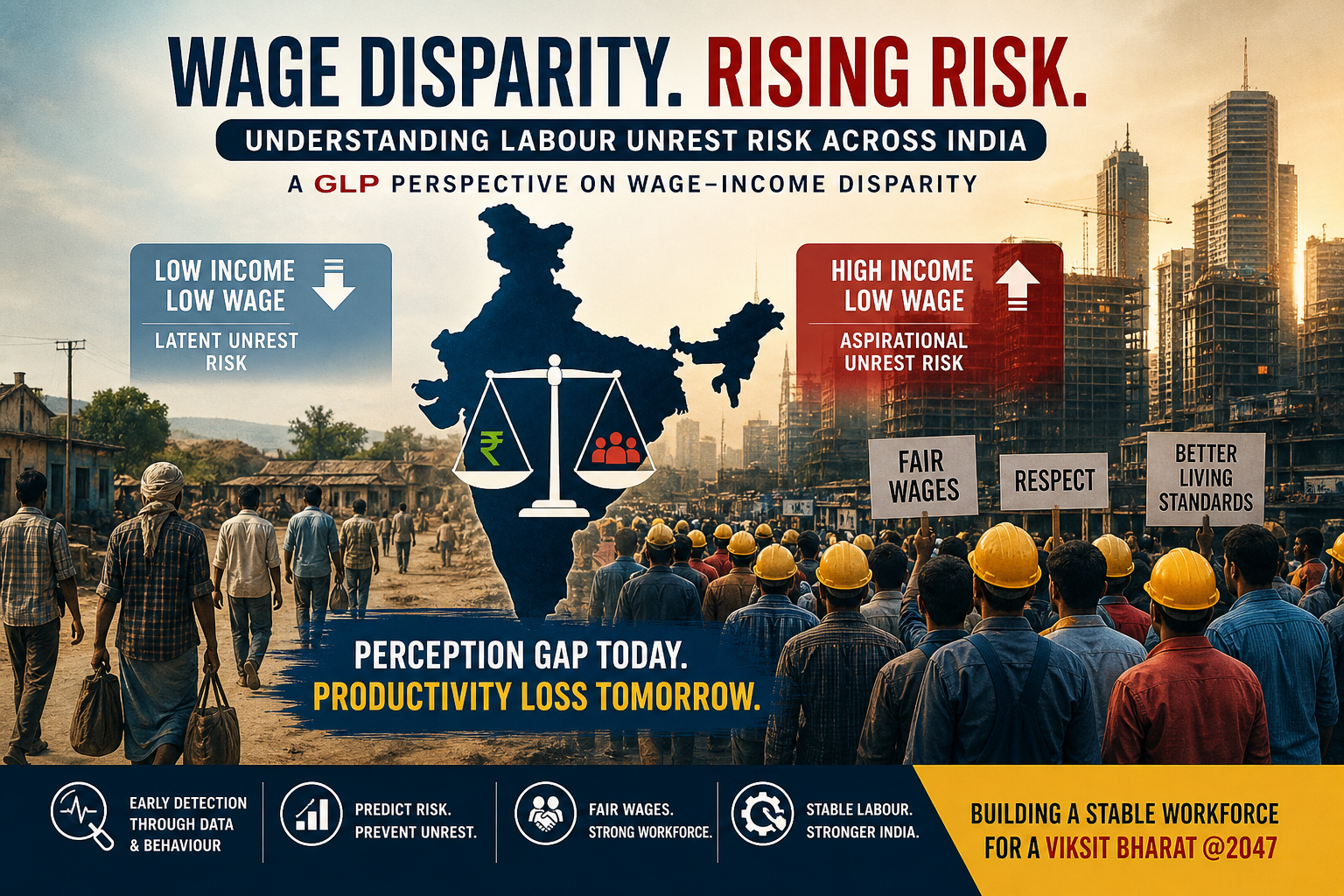
Labour unrest in India is increasingly influenced not merely by wage levels, but by the disparity between wages and regional per capita income. This report analyses state-wise data to identify patterns of economic imbalance and their implications on workforce stability.
The findings reveal three distinct labour market behaviours—aspirational unrest, latent instability, and volatility risk—each driven by different structural conditions. The report proposes a Gross Loss Prevention (GLP)-based framework for early detection and mitigation of labour unrest as a measurable economic loss factor.
1. Introduction
Labour stability is a cornerstone of industrial productivity and national economic growth. Traditionally, unrest has been attributed to low wages or poor working conditions. However, emerging data suggests a more complex reality.
Labour unrest is increasingly driven by relative economic perception, not absolute earnings.
This report evaluates the relationship between.
- Monthly wages (B)
- Monthly per capita income (C)
- Disparity gap (D = C – B)
- Relative disparity (%)
Labour Demand States
| STATE | MONTHLY WAGE (2026) (B) | MONTHLY PER CAPITA INCOME (2025) (C) | DIFFERENCE (D = C – B) | % DIFFERENCE (E = D/C) |
| Delhi | 18,456 | 41,085 | 22,629 | 55.08% |
| Tamil Nadu | 14,050 | 30,134 | 16,084 | 53.38% |
| Karnataka | 15,348 | 31,742 | 16,394 | 51.65% |
| Maharashtra | 13,325 | 25,778 | 12,453 | 48.31% |
| Gujarat | 13,325 | 25,079 | 11,754 | 46.87% |
| Kerala | 13,869 | 25,694 | 11,825 | 46.02% |
Labour Supply States
| STATE | MONTHLY WAGE (2026) (B) | MONTHLY PER CAPITA INCOME (2025) (C) | DIFFERENCE (D = C – B) | % DIFFERENCE (E = D/C) |
| West Bengal | 10,072 | 13,622 | 3,550 | 26.06% |
| Odisha | 12,012 | 14,080 | 2,068 | 14.69% |
| Madhya Pradesh | 12,425 | 12,718 | 293 | 2.30% |
| Uttar Pradesh | 13,690 | 9,048 | -4,642 | -51.30% |
| Bihar | 11,336 | 5,776 | -5,560 | -96.26% |
2. Data Overview and Key Observations
The dataset reveals significant variation across Indian states, broadly classified into three economic zones.
2.1 High Disparity – High Income States (Demand Centres)
Examples. Delhi, Tamil Nadu, Karnataka, Maharashtra
- Wage levels significantly lower than per capita income
- Disparity range. 46%–55%
Interpretation.. Workers in these states are exposed to.
- Higher standards of living
- Visible economic prosperity
- Increased consumption benchmarks
Risk Outcome. Aspirational Labour Unrest
- Rising wage demands
- Organised union activity
- Increased attrition and job switching
2.2 Moderate Disparity States (Transitional Stability Zones)
Examples. West Bengal, Odisha
- Disparity range. 15%–30%
Interpretation.
- Balanced but fragile labour markets
- Lower exposure to wealth inequality
Risk Outcome. Latent Unrest Risk
- Stability under normal conditions
- Vulnerable to triggers such as.
- Inflation
- Wage delays
- Political mobilisation
2.3 Negative Disparity States (Supply Economies with Distortion)
Examples. Uttar Pradesh, Bihar
- Wages exceed per capita income (negative gap)
Interpretation.
- Economies driven by outward migration
- Local income levels remain suppressed
Risk Outcome. Volatility Risk
- Sudden labour shortages
- High workforce mobility
- Informal unrest (absenteeism, productivity loss)
3. Key Drivers of Labour Unrest
3.1 Relative Deprivation
Workers assess fairness based on comparison with surrounding income levels.
3.2 Cost-of-Living Imbalance
Urban wage structures often fail to match real consumption costs.
3.3 Migration-Induced Expectation Shift
Exposure to higher wages elsewhere alters worker expectations.
3.4 Informal Economy Distortion
Parallel earnings (gig work, informal trade) influence wage perception.
4. Early Detection Framework
To prevent labour unrest, organisations must shift from reactive to predictive monitoring.
4.1 Wage-to-Income Ratio (WIR Index)
| WIR Range | Interpretation | Risk Level |
| < 0.5 | High disparity | High |
| 0.5–0.9 | Moderate | Medium |
| > 1 | Market distortion | Volatile |
4.2 Behavioural Indicators
- Rising absenteeism
- Increased grievances
- Overtime refusal
- Worker clustering or informal group discussions
4.3 Digital Sentiment Analysis
- Monitoring worker communication channels
- Tracking complaint trends
- Anonymous feedback systems
4.4 Benchmark Deviation Monitoring
- Wage deviation >10–15% from local market = early warning signal
4.5 Migration Flow Analysis
- Seasonal labour movement patterns
- Sudden attrition spikes
5. Mitigation Strategies
5.1 Dynamic Wage Structuring
- Location-based wage adjustments
- Cost-of-living allowances
5.2 Perception Management
- Transparent communication of total compensation
- Career progression visibility
5.3 Non-Wage Benefits
- Housing support
- Food and transport subsidies
- Healthcare access
5.4 Skill-Based Wage Progression
- Certification-linked pay increases
- Defined growth pathways
5.5 Balanced Workforce Strategy
- Mix of local and migrant labour
5.6 Real-Time Grievance Systems
- Digital resolution platforms within 24–48 hours
6. GLP Framework Integration
Under the Gross Loss Prevention (GLP) approach.
Labour unrest is treated as a preventable economic loss, not merely an HR issue.
Proposed System. Labour Stability Index (LSI)
A predictive model combining.
- Wage disparity
- Behavioural signals
- Attrition rates
- Regional economic indicators
Technology Integration Opportunity.
Deploy within platforms like.
- Workforce management systems
- Industrial command centres
- Smart city labour monitoring systems
7. Macroeconomic Implications
Labour instability leads to.
- Loss of productive man-hours
- Supply chain disruptions
- Reduced industrial efficiency
GLP Insight.
Every labour disruption is a direct subtraction from GDP potential
8. Conclusion
The analysis establishes that.
- Labour unrest is psychological, not purely economic
- Disparity—not poverty—is the dominant trigger
- Migration amplifies instability across regions
Final Insight
“Labour unrest emerges when expectation exceeds economic alignment.”
Policy & Industry Recommendation
India must transition towards.
- Predictive labour risk intelligence systems
- Integration of labour analytics into economic planning
- Adoption of GLP principles in workforce management